
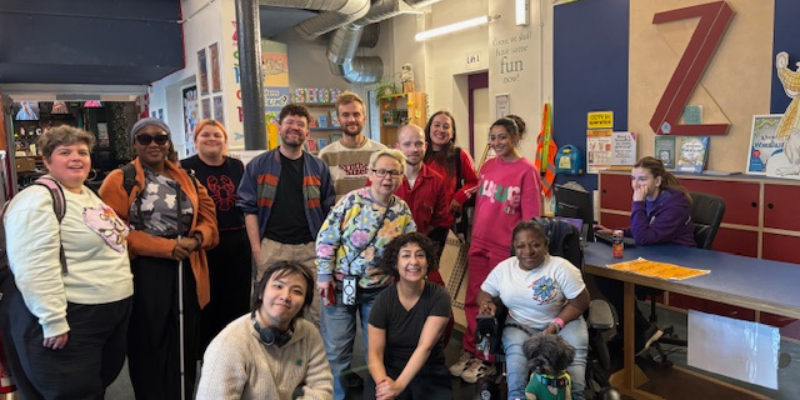
Image: Group photo of 12 people of mixed ages and ethnicities, smiling and laughing at the camera.
We are delighted to share findings from our VX Lab on creating disabled-led theatre for children and young people which took place a few months ago here at Z-arts in Manchester.
The Lab explored the importance of working creatively with those with lived experience and with the inclusion of children and young people, challenged assumptions, and affirmed that complex, ambitious work belongs on stage for young audiences.
It asked how theatre can be made for and with children and young people when accessibility is assumed as a creative opportunity, and how this approach can be embedded as a contractual imperative in the commissioning of all work for young audiences.
As Josh Elliott, Artistic Director said:
“This Lab prioritised creating a space for children and young people to share the full arc of their theatre experience from entering the building to leaving it, and in doing so created a clear mechanism through which their wishes, frustrations and responses could directly shape work made for them”
Why does it matter to Z-arts?
The Lab grew out of a conversation here at Z-arts, the Manchester-based arts organisation dedicated to children and families. There was recognition of excellent work across the country in accessible theatre for children and young people, and high-quality disabled-led theatre for adults.
Both Z-arts and Vital Xposure were, therefore, looking to use this Lab opportunity to push forward the conversation rather than replicate what others were doing.
This felt like an opportunity to join forces and explore what is possible, specifically for new, disabled-led theatre for early years’ children and young people.
The research was driven by the desire to make the process of creating accessible work for children and young people more transparent and available, reducing the need for repeated learning across the sector. The aim was to develop a practical ‘toolkit’ that could be used by venues, artists, and theatre makers.
From Z-arts perspective in particular, as Liz O’Neill, CEO and Artistic Director, explained:
“The intention is to use this learning ourselves in future commissions, but also to share with artists who come through our development programme and the wider sector”.
How did we do it? We consulted organisations and artists in Greater Manchester months before. Disabled artists to lead on the artistic development were recruited early on: they started shaping the Lab through introductory workshops with children and young people.
Co-creation, as an equitable collaborative process, was key from the outset.
Neither of the Lead Artists were precious about the process, but held the space for others to move into. People were able to say, ‘what if?’ or ‘what then?’ without worrying about being quashed.
What did we learn? It’s invaluable to allow artists with lived experience of why accessible theatre is needed for children to lead the process. Creating theatre for and with children and young people can be both taken seriously and fun.
Interstitial spaces matter. These refer to “spaces between structures”: admin, logistics, planning, good coordination of practicalities, including access.
Crucially, the Lab demonstrated that accessible theatre for children is not a compromise on artistic quality, but a driver of it.
Read the report from the VX Lab: Children and Young People.
What happened next? After a joyous staging of a small, new theatre piece on the last day of the Lab at Z-arts, the immediate next step was to ensure the legacy of the learning: the Lead Artists were commissioned to develop a toolkit for making accessible, inclusive theatre for and with children and young people. This toolkit – expected in early 2026 – will be aimed at informing commissioning processes for new work.
Building on this research, we have commissioned an R&D for When I See Blue, an authentic and affecting story for young people about living with OCD, written by author and mental health activist, Lily Bailey.
“Putting learnings from the Lab into practice, this exciting R&D will explore how to physicalise the interior experience of OCD on stage, and how to make theatre that neurodivergent young audiences can access without the usual barriers, grounded in lived experience in the room and with children feeding into the process, to discover what a Lab-informed production can look like on stage.”
Adapted by Josh Elliott from the Lily Bailey novel, the R&D for When I see Blue will be directed by Nickie Miles-Wildin with dramaturgy by Lu Kemp. It will be hosted by development partner Polka Theatre and has been supported by The Roald Dahl Story Company.
Further, VX Labs have included Creating a Playscript in BSL in partnership with Sheffield Theatres, Decolonising Disability Lab in partnership with Bristol Old Vic, and the Creative Captioning Labs.
Read more about the VX Labs Programme